The CritiCall test is a shift, not a quiz.
Pass911 is a desktop practice simulator for the CritiCall® test, a computerized exam for 911 dispatcher and call-taker applicants. You type caller records into upper-case fields while emergency messages cut in, send each one to Police, Fire, EMS or Utility, and take down details a caller dictates once. Thirteen modules, each on its own clock.
Biddle's candidate guide gives you 15 seconds to answer each emergency message. A wrong agency or a late answer earns no credit.
Free sign-up, no card. Runs on a computer with a keyboard and headphones or speakers.
What the CritiCall exam is
CritiCall is a computerized work-sample test that simulates a dispatch environment. Biddle Consulting Group, its publisher, says it contains over 20 tests, and each hiring agency chooses which ones you take. Published batteries run from 3 modules (Scottsdale) to 15 (San Diego, 2011).
Session length varies just as much. Biddle says the test takes, on average, between one and three hours; published sessions run from 50 minutes (Scottsdale, three modules) to about two and a half hours (San Diego). No dispatch background is assumed: Biddle says applicants need no prior dispatch experience or special dispatcher training to succeed. What the CritiCall dispatcher test measures is speed, accuracy and doing two things at once. More on how long it runs and how hard it is.
13 practice modules, one drill each
Every module opens with untimed practice items that don't count, then a timed section. That's the order Biddle's candidate guide describes.
- Emergency messages. They pop up over your data entry. Send each to Police, Fire, EMS or Utility under the rules on screen, inside 15 seconds.
- Data entry, written. Nine upper-case fields, Last Name to Driver's License, in Biddle's published order.
- Data entry, audio. A caller dictates the record: in screen order at first, then in fragments, out of order.
- Keyboarding. Five minutes copying a written passage.
- Call summarization. Hear a call, type a summary or fill the fields, then answer questions from your notes and memory.
- Map reading. The most direct legal route on a basic street grid, past one-way streets and turn signs.
- Memory recall. Word pairs that vanish; numbers and codes you hear once and type moments later.
- Cross referencing. Directories, written and spoken requests, same-or-different pairs.
- Prioritization. Sort calls into priority levels under our written rules.
- Reading comprehension. Procedure passages from fictional dispatch centers.
- Spelling. Dictated words and sound-alikes.
- Sentence clarity. Four versions of the same facts. Pick the clearest.
- Character comparison. The exact match among near-identical letter and number strings.
Biddle publishes no per-module timings or item counts. Ours are set from the session lengths agencies publish: 10 minutes per module, 16 for data entry with emergency messages and 5 for keyboarding. We wrote every rule, record, call, map and passage, so none of it is a CritiCall item. What each drill covers is on our CritiCall practice test page.
Results, labeled honestly
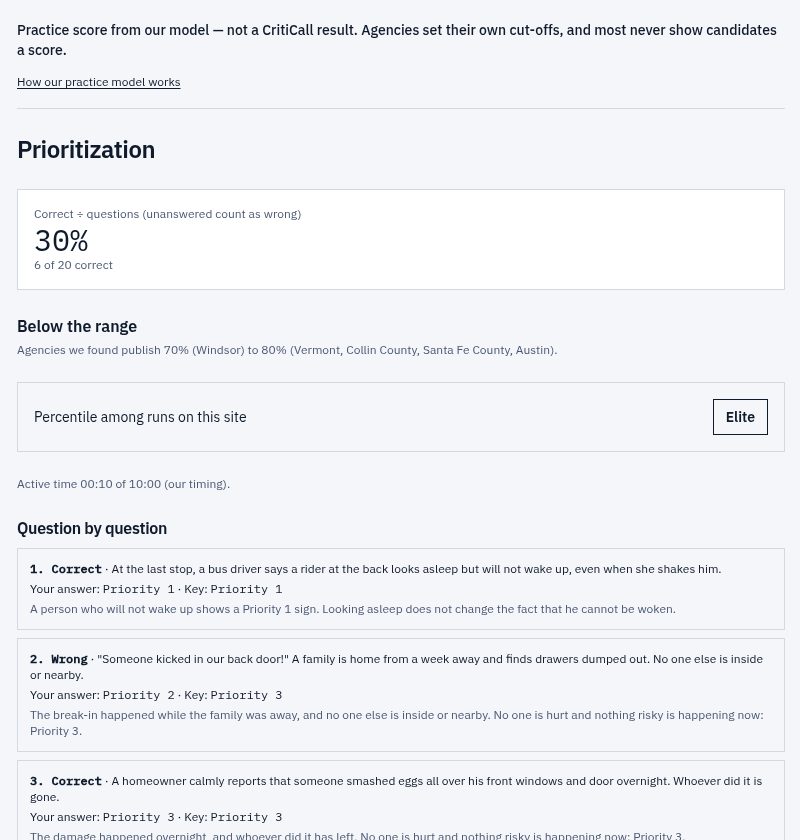
Practice score from our model — not a CritiCall result. Agencies set their own cut-offs, and most never show candidates a score.
That label heads every Pass911 results screen, and it's why the screen is worth having. Scores from the test itself belong to the agency, according to Biddle's TestGenius help desk, and most agencies do not give out test results. Usually you learn only whether you advance, made a list or did not pass.
Here, each module gets a percentage and a band: Above the bar (80% and up), In the range (70–79%) or Below the range (under 70%). Agencies we found publish 70% (Windsor) to 80% (Vermont, Collin County, Santa Fe County, Austin). Keyboarding is checked against the 30, 35 and 40 wpm bars agencies publish. Data entry shows net keystrokes per hour, our measure, because no agency we found publishes a data-entry bar. Elite adds the overall picture: your weakest module, your unweighted average and, once 30 completed runs of a module exist, your percentile.
In our practice model, a skipped item counts as wrong, because Biddle's guide penalizes skipping unless a section's instructions say otherwise. Where every number on the screen comes from is spelled out in how our scoring model works.
Start free, pay once if you want more
The free run is audio data entry with emergency messages: a caller in your headphones, nine fields to fill and messages landing on a 15-second clock. A list of sample questions can't rehearse that. One full run, 16 minutes on our timing, free with sign-up and no card. The free CritiCall practice test page shows exactly what's included. To check your typing speed first, the free 911 dispatcher typing test takes five minutes and needs no sign-up at all.
Then there are two plans. Starter, $39: every module as a drill, unlimited. Elite, $69: everything in Starter plus full timed batteries. Starter holders upgrade for $30. Both are one-time payments with 12 months of access and a 7-day money-back guarantee, priced in USD.
What rides on the sitting
At agencies such as Tempe, Newton, Colorado State Patrol and San Diego, CritiCall comes early: candidates who pass go on to an interview, then background, polygraph, psychological and medical steps, in an order each agency sets. At agencies like Newton and Cambridge, one sitting decides the current hiring round. Passing isn't always enough, either. Arizona DPS ranks the candidates who pass and invites them in rank order; Colorado State Patrol invites the top scores to interview.
BLS puts median pay for public safety telecommunicators at $53,040 a year (May 2025). The format is learnable. Learn it before the sitting, not during it.
Questions
Is the CritiCall test difficult?
Not because of what you need to know: no dispatch experience is required, per Biddle. The pressure comes from the clock, with 15 seconds per emergency message while a record sits half-typed.
What happens if I fail the CritiCall test?
Your agency decides. Palo Alto gives applicants two opportunities to pass; after that they are out of the process. Newton and Cambridge don't reconsider a candidate who fails in the current process, though they can apply for future openings. In Canada, RCMP BC allows a retake after a two-week wait, then a three-month wait before reapplying after a second failure. No US agency page we read publishes a waiting period.
Does Pass911 use CritiCall's own test items?
No. Biddle says there is no "practice test" for CritiCall and that it "absolutely cannot give out the demo" to applicants. Every item here is original, written to the format Biddle and the agencies describe.
Can I practice on my phone?
Sign up and read the guides there. Runs need a computer with a keyboard and headphones or speakers, so on a phone we email you the link.
Your first full run is free. Take it tonight.
Free sign-up, no card. Paid plans: one-time, with a 7-day money-back guarantee.